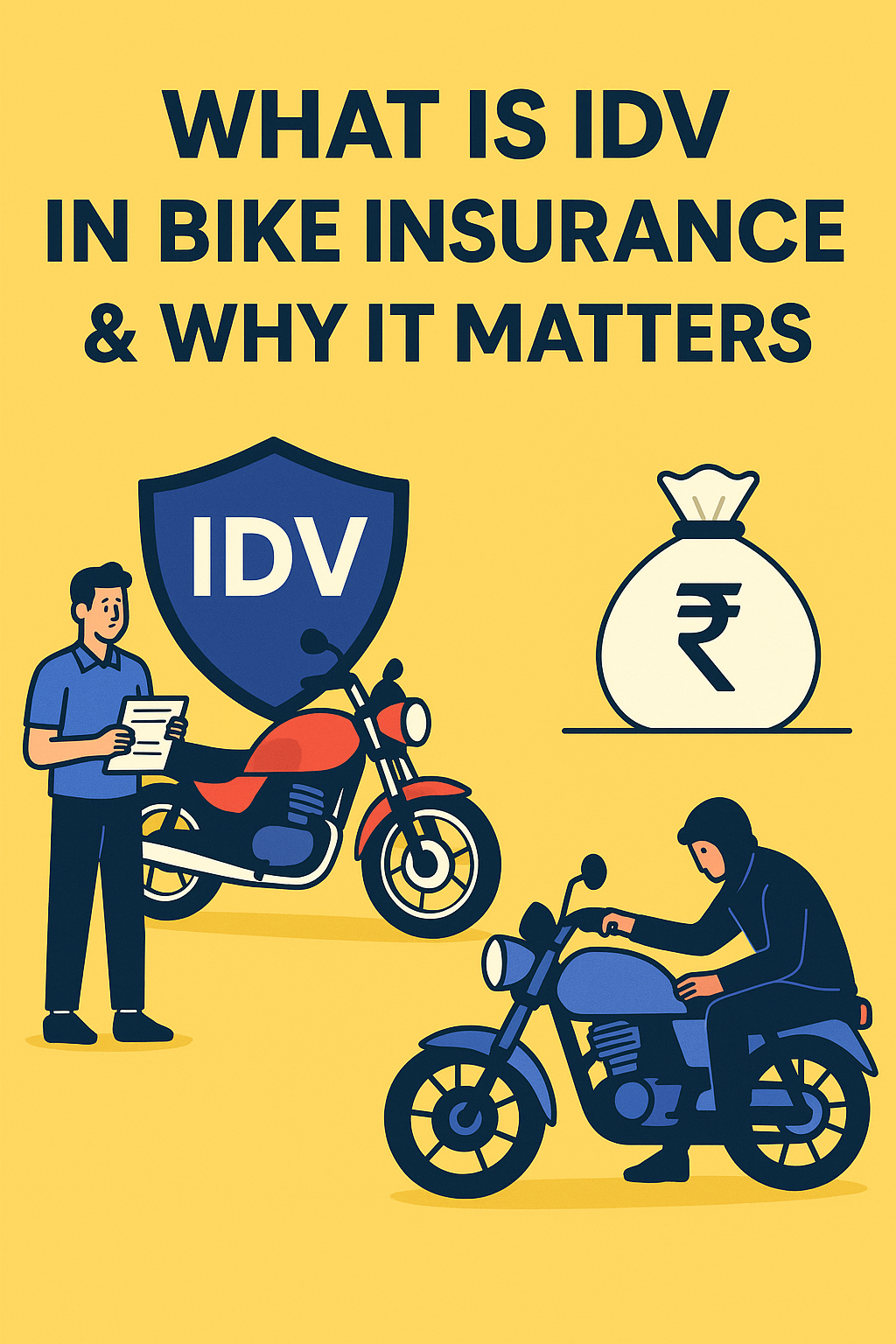
IDV in Two Wheeler and Four Wheeler Insurance
Everyone of us own at least one two-wheeler and most of us also own a four-wheeler. Whether it is a scooter, bike, car, or SUV, all vehicles must have active insurance coverage when being used. In earlier days, we often considered insurance as a legal formality. However, with rising vehicle and repair costs, insurance now plays a crucial role in ensuring financial compensation during accidents or theft.
Contrary to common assumptions, vehicle insurance does not guarantee reimbursement of the full vehicle price. It only covers up to the IDV or Insured Declared Value, which is the maximum amount an insurer agrees to pay, evaluated by their surveyor.
Understanding IDV
IDV stands for Insured Declared Value and refers to the current market value of your vehicle minus depreciation. It is the maximum sum assured by the insurer that you will receive in case your vehicle is stolen or completely damaged beyond repair. Also acts as the maximum sum insured in case of total loss or theft. Your insurer calculates IDV annually based on vehicle age and depreciation guidelines.
Real-Life Scenario: Bike Theft
Consider this scenario. Aakash bought a bike for ₹1.3 lakhs and insured it with an IDV of ₹1.12 lakhs. A few months later, the bike was stolen. He filed an FIR and informed his insurer. After investigation, the insurer agreed to settle the claim, but the payout was slightly lower than ₹1.12 lakhs due to depreciation adjustments — this is standard practice.
Real-Life Scenario: Car Accident
Now, assume a car worth ₹25 lakhs has an IDV of ₹19.25 lakhs. If the car meets with an accident, the insurer will assess the damage using a surveyor. If the damage is repairable, the insurer pays the approved amount. If the vehicle is beyond repair, they might reimburse the IDV.
How IDV Is Calculated
IDV is generally calculated using this formula:
IDV = Manufacturer’s Listed Selling Price – Depreciation
*The depreciation depends on the age of the vehicle. For example:
- Up to 6 months – 5% depreciation
- 6 months to 1 year – 15%
- 1 to 2 years – 20%
- 2 to 3 years – 30%
- 3 to 4 years – 40%
- Above 5 years – Based on mutual agreement
*The above is for illustration purposes only and the actual decpreiation numbers may vary
Why IDV Matters
- Claims Are Limited to IDV: No matter how much you paid for the vehicle, your claim cannot exceed the IDV.
- Affects Premium: Higher IDV means a higher premium, but also better coverage.
- Important in Total Loss Cases: Knowing your IDV helps manage expectations during theft or total damage.
Tips to Handle IDV Smartly
- Don’t opt for very low IDV to reduce premiums. It can backfire during claims.
- Ask your insurer how they calculate depreciation annually.
- During renewals, compare IDV offered by different insurers.
- If you plan to sell your vehicle, a higher IDV makes it more valuable to a buyer.
- Ask your agent or POSP to explain how your IDV was arrived at.
In conclusion, IDV is not just a number—it’s the maximum lifeline your insurer provides when the worst happens. Choose it wisely and stay informed!